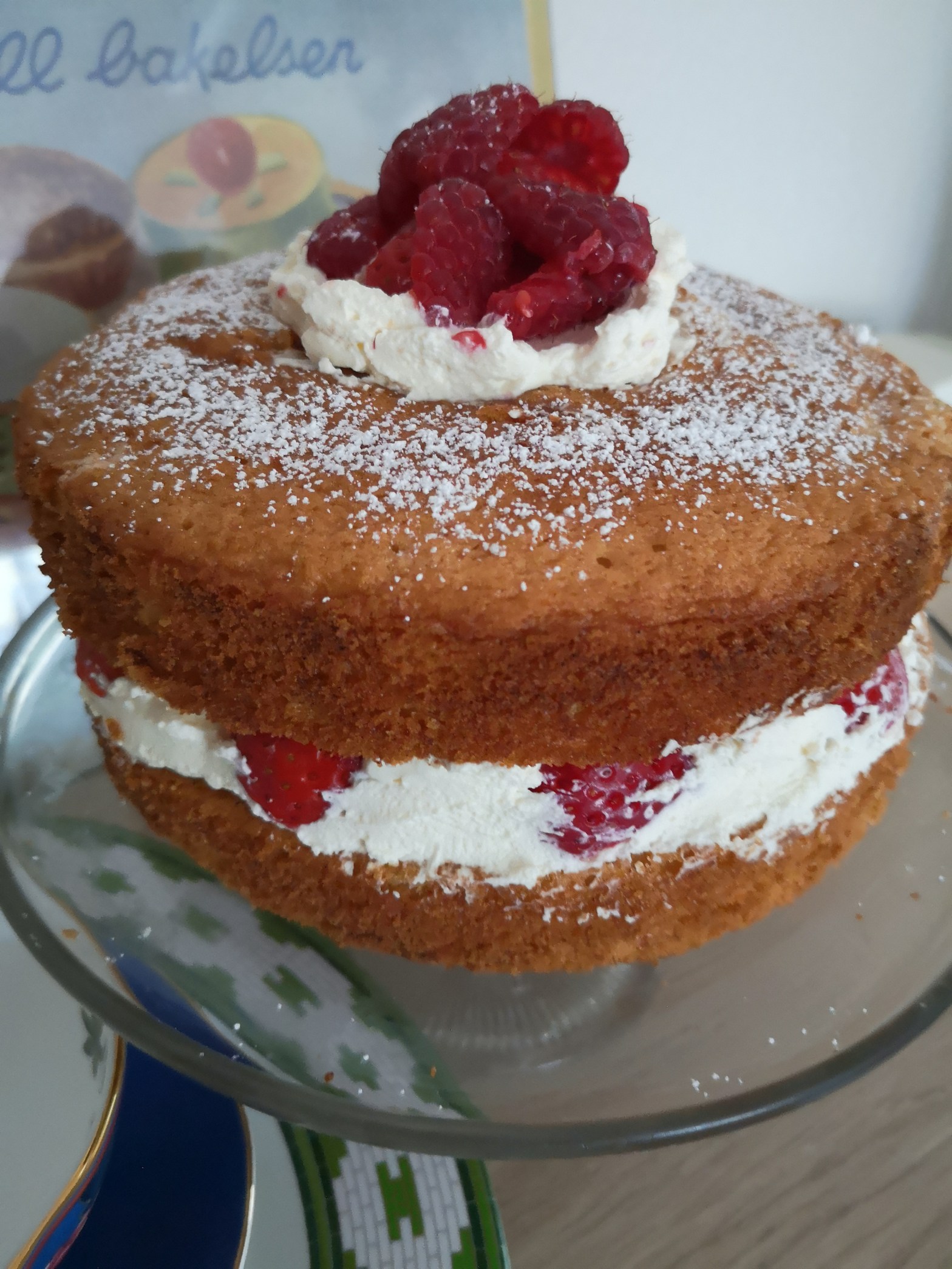
I baked a Victoria sponge this weekend. That light and airy cake which somehow seems to symbolise teatime in ways nothing else does. There are so many childhood memories of there always being one of these on the table if we went to spend time with my grandparents. Full of cream and fruit, dusted with icing sugar, the sort of cake where you always hope someone is going to ask if you would like a second slice.
As you might have guessed the cake is named after Queen Victoria, who apparently adopted the new habit of afternoon tea in the mid 1800’s. The Victorians somehow managing to squeeze in yet another meal amongst the copious amounts they were already eating. The sponge cake the Queen was served rapidly became a favourite and one of the first printed recipes referring to it by name was in Mrs Beetons Book of Cookery and Household Management which was published in 1871.
It’s not just the childhood memories that make me such a fan of this cake. There’s also the fact it’s one of the few things I ever got to bake for my mother. It was her 80th birthday and as was so often the way with my mother she was adamant she didn’t want a fuss, but we did manage to persuade her to have a small family gathering. I hadn’t been baking for long at the time but the opportunity to make a cake with ‘Happy Birthday’ iced on top, as she had done for me so many times in the past, was too good to resist. I also knew that I didn’t need to worry too much about sugar or cream levels as mum had a life long sweet tooth. Something I’ve probably inherited from her. That was a few years ago now but it’s still one of my favourite baking memories.
I used Mary Berry’s recipe for mum’s cake and it’s the same one I used this weekend. In principle a Victory sponge is quite a simple bake but there are a few things, I’ve highlighted them below, which I believe make Mary’s recipe extra special. If you follow her tips you will have a beautifully light cake.
Ingredients
- 180g unsalted butter – must be at room temperature
- 180g caster sugar
- 180g self raising flour
- 3 eggs
- 0.75tsp vanilla extract
- 1tbsp warm water
Method
- Heat the oven to gas mark 4. Grease and line the bottom of 2 20cm cake tins
- Put the soft butter in a mixing bowl or electric mixer. Beat the butter until it is very creamy. It needs to be the consistency of mayonnaise.
- Scrape down the sides of the bowl with a spatula then beat in the sugar, a couple of tablespoons at a time. After this scrape down the sides of the bowl again.
- Put the eggs and vanilla into a small jug or bowl and mix together. Gradually add to the butter mixture a tablespoon at a time. To avoid the mixture splitting add a tablespoon of the measured flour with each of the last two additions of egg.
- Sift the rest of the flour into the mixture. Start to gently fold it in with a spatula. After the 2nd or 3rd fold add the tablespoon of warn water to the mixture. Continue folding until everything is combined.
- Split the mixture between the two tins and bake for 20 to 25 minutes. The cakes should be a light golden brown and springy to the touch when they are ready.
- Leave the cakes in the tins for just a couple of minutes after they come out of the oven before turning them onto a rack to cool.
The traditional Victoria sponge is then sandwiched together with fruit, whipped cream and jam in the middle. The top of the cake dusted with icing sugar. If you’re like me and have cream and fruit left over then forget tradition and put some on top as well.
 David in the kitchen.