Week four and we’ve reached chocolate on Bake Off. The temptation at this point is to ask ‘who doesn’t like chocolate’ and assume no one will put their hand up. I suppose there must be people who don’t but I’m not sure I’ve ever met anyone who’s made that claim.
This particular week in the series always feels to me like a challenge of the extremes, at one end you have relatively straight forward cakes and brownies, while at the other there are complicated constructions, requiring tempered chocolate and a whole host of skills which most bakers are quite unlikely to have ever used before.
Brownies were the signature bake on this show. The contestants tasked with making a dozen using their own favourite recipe. The trap which virtually all of then fell into was not knowing when to stop. Rather than just concentrating on a good brownie, moist in the middle and almost crisp on the outside, they all added extra layers and ingredients. Given the show they were on it’s understandable, but the outcome was a brownie selection where in almost every case the judges felt them just too sweet and rich. Proof, if proof were needed, that there are some bakes where getting the basics right is really all you need.
The showstopper challenge was to produce a multi-layer, decorated chocolate cake. There were some beautiful creations and next time I get asked to bake for a birthday or other special occasion I may well be tempted to have a go.
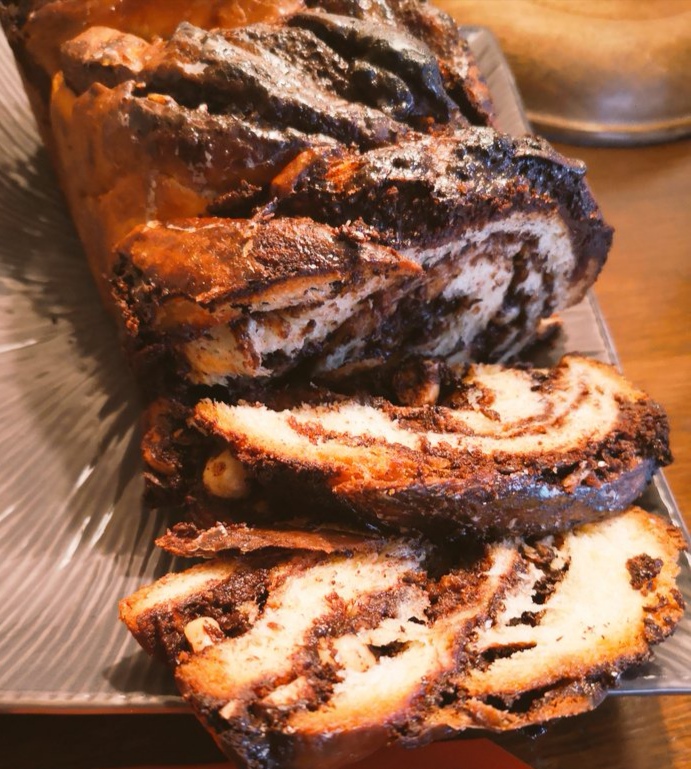
For the first three shows of this series, I’ve baked my version of the signature challenge, this time I went with the technical option and baked a babka. To be honest, before this week my knowledge of babka didn’t go much beyond remembering the Seinfeld episode where Elaine & Jerry were frustrated in their efforts to take one to a dinner party. In the last few days I’ve been doing some background reading and now know they originated in the Jewess communities of Poland and Ukraine and are particularly popular in Israeli and New York bakeries, hence the Seinfeld episode.
Now I’ve made one and tasted babka for the first time I’m an instant convert. The mixture of the soft, rich dough and the hazelnut filled chocolate in each bite is gorgeous. The many stages of the process and the time needed for proving may mean this isn’t an everyday bake, but there will definitely be babka again soon in this house.
Please don’t be put off by the length of the recipe. The process is broken down to a very granular level, so your hands-on time is not as bad as it might look at first glance. The times listed for proving the dough are a minimum and you can leave it overnight if that’s easier for your schedule.
Ingredients
For the filling
- 65g blanched hazelnuts
- 100g unsalted butter
- 150g caster sugar
- 80g dark chocolate
- 40g cocoa powder
For the dough
- 275g plain flour
- 5g dried yeast
- 25g caster sugar
- 0.5 tsp salt
- 2 eggs, beaten
- 50ml milk, ideally full fat
- 80g butter
For the syrup
- 100ml water
- 100g caster sugar
Method
- Heat the oven to 200°C/180°C fan/Gas 6.
- Make the filling. Tip the hazelnuts into a baking tray and roast in the bottom of the oven for 4–5 minutes, tossing occasionally, until light golden. Tip onto a chopping board, leave to cool, then roughly chop half the hazelnuts and finely chop the remainder. Set aside.
- Place the butter, sugar and chocolate in a pan and melt very slowly over a low heat, stirring until smooth and combined. Remove from the heat and stir in the cocoa powder. Pour into a bowl and leave to cool and thicken slightly.
- Meanwhile, make the dough. Tip the flour into the bowl of a stand mixer fitted with the dough hook, add the yeast to one side of the bowl and the sugar and salt to the other side.
- Make a well in the centre and pour in the eggs and milk, then mix on slow speed for 2–3 minutes, until firm.
- Increase the speed to medium and add the butter, a little at a time. Mix well between each addition, allowing the butter to incorporate before adding more.
- Once you have added all the butter, continue kneading with the dough hook on medium speed through the sticky stage, until you have a ball of smooth, silky, shiny dough. Be warned that this stage can take quite some time. Probably longed that you have ever had to knead dough before.
- Lightly flour a work surface and roll out the dough to a 40 x 30cm rectangle, with a long edge closest to you.
- Spread the cooled chocolate mixture over the dough, leaving a 1cm border all around. Sprinkle all the toasted hazelnuts over the top.
- Starting from the long edge closest to you, roll up the dough into a tight spiral, with the seam underneath.
- Trim about 2cm off each end to neaten, then turn the roll through 90° clockwise so that a short end is closest to you. Using a large, sharp knife or a pizza cutter, slice lengthways, down through the middle of the dough, cutting it into 2 long pieces.
- With the cut-sides facing upwards, gently press the top end of each half together to seal, then lift the right half over the left half, followed by the left half over the right half. Repeat, twisting the dough to make a two-stranded plait, then gently press the bottom ends together to seal.
- Carefully lift the loaf into the lined tin and cover with a clean tea towel (or place in a proving bag, if you have one). Leave at room temperature for about 2 hours (or in a proving drawer for 1 hour), until doubled in size.
- Fifteen minutes before the end of the proving time, heat the oven to 190°C/170°C fan/Gas 5.
- When the babka has proved, bake it for 15 minutes, then reduce the oven temperature to 170°C/150°C fan/Gas 3 and cook for a further 25–30 minutes, until a skewer inserted into the centre comes out clean.
- While the babka is baking, make the syrup. Tip the sugar and 100ml water into a small pan, bring to the boil over a medium heat, stirring until the sugar dissolves. Reduce the heat and simmer, without stirring, for 5 minutes, until syrupy. Leave to cool.
- When the babka is ready, transfer it in the tin to a wire rack. Brush the cooled syrup over the hot babka, then leave in the tin until warm enough to handle. Turn out onto the wire rack and serve warm or at room temperature.
 David in the kitchen.