
Every Saturday my friend WaxeWod puts a happy list post on her blog and asks her followers, should they feel inclined, to follow suit.
I find it quite therapeutic, a way to look back over the previous few days, often realising it’s the smallest things that make you happiest.
If I was to expand the concept, making it a list of things which always make me happy, whether they’ve happened in the last week or not, pomegranates would be high up there.
It probably goes back to spending part of my childhood in Malta, where pomegranates grow all over the island. Unlike any fruit I’d tried before, they had an exotic edge to them. Picking out the crunchy seeds to eat, then scooping up any juice left behind. I remember this always worried my mother as she was convinced we were going to spill the juice and stain our clothes.
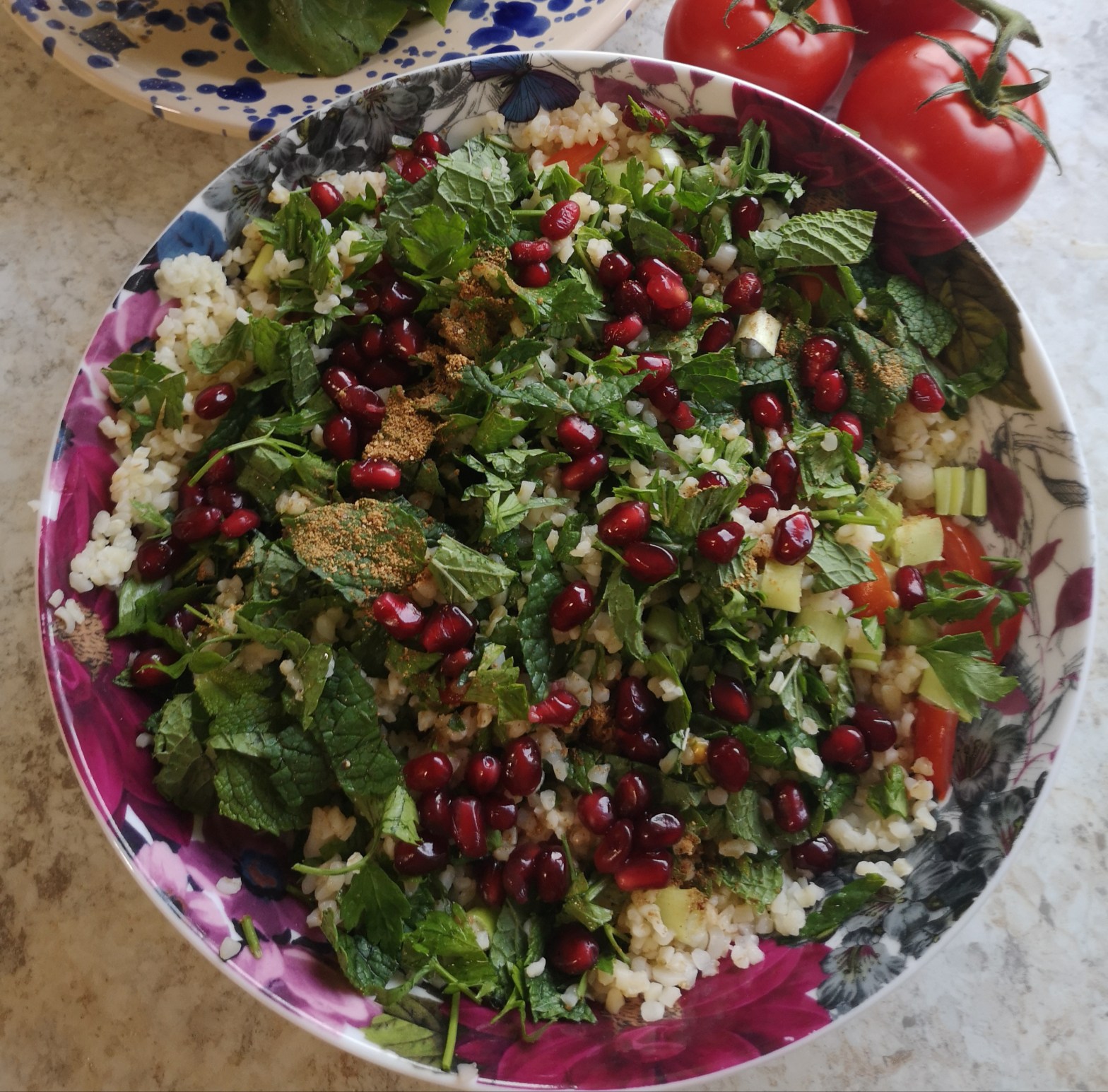
These days there’s always a bottle of pomegranate molasses in my fridge and any recipe which uses them will catch my eye. Hence my first attempt at making a tabbouleh. A dish that not only tastes good, but looks rather wonderful on the plate as well.
The recipe that prompted me to was from Felicity Cloake’s column in the Guardian and the link will take you there. I’m also going to share what I did, as I didn’t have all of Felicity’s ingredients to hand.
Felicity’s original recipe was for four, I was cooking for two
Ingredients
- 20g fine bulgar wheat
- 150g ripe tomatoes
- 3 spring onions
- 1 lemon
- 0.25tsp ground black pepper
- 0.25tsp ground cinnamon
- 0.25tsp ground coriander
- 0.25tsp ground nutmeg
- 0.25 tsp ground ginger
- 25g fresh parsley…Felicity uses way more fresh herbs than this. I went with 25g of each as that’s what I had to hand. If you have more then by all means use more
- 25g fresh mint
- 60ml olive oil
- 2 tbsp pomegranate seeds
- Lettuce and/or flatbread to serve with it….I used pitta bread
Method
- Prepare the bulgar according to the instructions on the packet. Place in a bowl, fluff it up with a fork and leave to one side.
- Dice the tomatoes, retaining any juice, and trim and finely slice the spring onions. Add both, and the tomato juices, to the bulgar and mix.
- Squeeze the juice of half the lemon into the bulgar and mix again.
- Mix all of the spices in a small bowl, then add them to the bulgar bowl.
- Wash and dry the fresh herbs. Remove the parsley leaves from the stalks.
- Slice the parsley leaves as finely as you can. Don’t be tempted to use a food processor as this will make them soft and mushy. Use the same slicing method for the mint leaves. Then add both, along with the olive oil, the juice of the second half of the lemon and some salt to the bulgar bowl. Mix everything thoroughly, incorporating the herbs into the other ingredients.
- Scatter the pomegranate seed on top.
- Prepare some lettuce leaves and toast some flatbread.
I was checking online about Maltese pomegranates before I started writing and discovered this liqueur. Hopefully, it will be added it to the happy list soon.
 David in the kitchen.
I have made tabbouleh but not in recent years. I very much liked it so maybe I should try again? But I don’t remember pomegranates being part of it. However, I grew up in an area that had lots of pomegranate trees (bushes?) and my mother had that same fear – we would stain out clothes with that juice. To be honest, as kids we weren’t particularly interested in doing the work of eating the fruit. We mostly wanted to use them the way people in colder climes use snowballs! Pomegranate fights! I now realize what a sad waste but kids. You know.
LikeLiked by 1 person