Discovering new flavours

I’m the person who often picks the dish he doesn’t recognise on the menu. The person who then sits wondering what’s going to be delivered to the table. Hoping for a new food experience, eager to be the envy of my dining companions, running the risk of leaving them thinking ‘will he never learn’.

It hasn’t always worked in my favour. I ordered boudin blanc in a French restaurant once and was presented with one of the richest heaviest things I’ve ever eaten. I remember finishing the plate, almost as a matter of pride, but then regretting it through the course of a very long night. The first time I inadvertently ordered tripe on another trip to France was quite a surprise, although it has subsequently gone on to be a favourite. Then there was the eel soup in Antwerp, accompanied by a glass of Troubadour Obscura. An interesting soup, a fabulous beer.

More often than not it works. It isn’t always a complete mystery, it can be a dish made with ingredients I recognise but which I’ve never previously eaten as a combination. The first time of trying chilli and chocolate together springs to mind. 

Of all the things I’ve missed this year, restaurant eating is pretty high up the list. Here in the UK, they have been reopened to a fashion for the last few months, all be it with many and various coronavirus restrictions. Somehow with these and the requirement to shield my partner’s 89-year- old mother who lives with us, we’ve found it difficult to be tempted back over the restaurant threshold.

So for now I’m having to try and create new food experiences at home. Looking for recipes and new ingredients to play with. It’s a quest that’s been greatly helped by Flavour, the new cookbook by Yotam Ottolenghi. Yotam has published several books already and also has a selection of recipes in the Guardian every weekend. His recipes are never less than interesting and in this book, he pushes the boundaries even further. The theme of the book is about layering multiple flavours within one dish and in doing so he uses many items new to me. A list of 20 key ingredients includes Shaoxing, a wine fermented from rice, Masa harina, a flour made from corn and Gochujang chilli paste. I’ve no idea what these will taste like, but it takes me straight back to that restaurant menu and a strong desire to try them. I’m not sure of the chances of our local food stores stocking them, but I’ll be on the hunt when we next go.

As I delve further into this wonderful book I’ll keep you updated on the new flavours I discover. So far the only dish I’ve made is aubergine dumplings alla parmigiana. Yotam’s recipes are always slightly challenging, this one took me a couple of hours one Sunday afternoon, but the taste of the meal and the feedback I got from those I was cooking for made it time well spent. 

Proof that if you can’t get out of the house for some culinary adventures, you can still do it at home.
Too much time, too little to do.

I forgot it was my fathers birthday at the beginning of this week, or perhaps I should say I momentarily overlooked it.

Ever since lockdown started back in March I’ve been calling him regularly to see how he is and when I did on Monday it went to answerphone so I left a message. I didn’t think any more about it until he called me that evening, during our conversation he said a friend had treated him to lunch. It was only when he also mentioned the present they’d given him that alarm bells went off in my head and I realised what I’d done. Thank goodness for next day Amazon deliveries.

It’s not that I wasn’t aware of his birthday coming up, just that as with so many things recently I was a bit vague about the details. For me, that pretty much sums up 2020.

March feels like an eternity ago, the coronavirus restrictions feel endless and in all likelihood are going to get tighter over the winter. At the same time weeks blend into each other and it’s a struggle to remember which month it is. Never mind which week or day. Then, of course, the clocks change tomorrow night, heralding the darker evenings.

The overriding thing I hear from people I speak to, although like everyone my social circle has shrunk dramatically, is they miss spontaneity and things to look forward to. With nothing outside of the norm happening it’s horribly easy to slip into a state of torpor.

So I’ve given myself a good talking to this week. Just because it’s the norm doesn’t mean you can’t have fun. When I was stuck in an office job which bored me witless I always said I needed more time to do other things. Well now I have that time and it’s up to me to use it. So expect more baking, more blogging and hopefully no more overlooked birthdays.

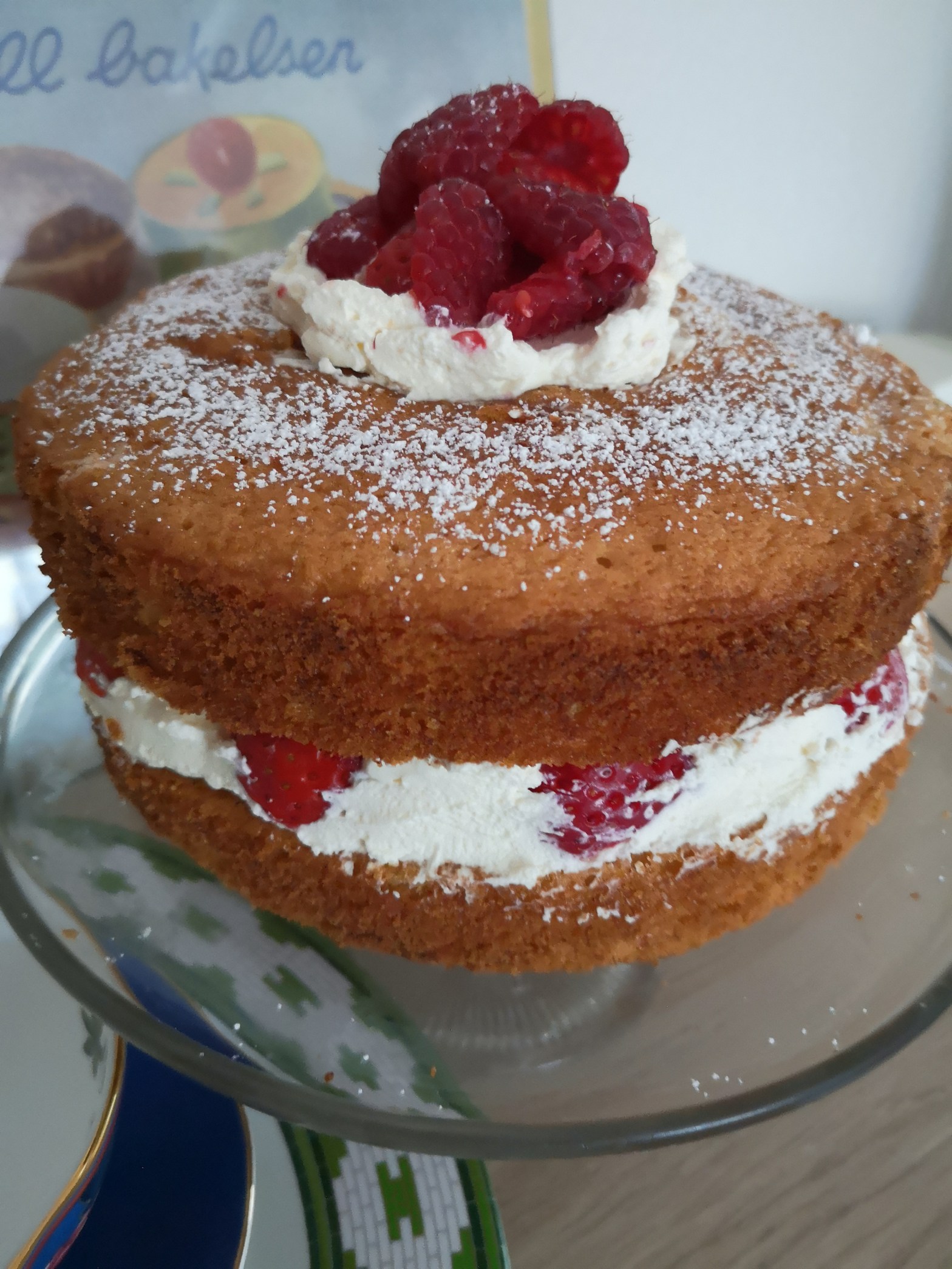
p.s We’re going to see my dad next week and I’ll make sure he gets a belated birthday cake.

Great British Bake Off 2020 week 4

Week four and we’ve reached chocolate on Bake Off. The temptation at this point is to ask ‘who doesn’t like chocolate’ and assume no one will put their hand up. I suppose there must be people who don’t but I’m not sure I’ve ever met anyone who’s made that claim.

This particular week in the series always feels to me like a challenge of the extremes, at one end you have relatively straight forward cakes and brownies, while at the other there are complicated constructions, requiring tempered chocolate and a whole host of skills which most bakers are quite unlikely to have ever used before. 

Brownies were the signature bake on this show. The contestants tasked with making a dozen using their own favourite recipe. The trap which virtually all of then fell into was not knowing when to stop. Rather than just concentrating on a good brownie, moist in the middle and almost crisp on the outside, they all added extra layers and ingredients. Given the show they were on it’s understandable, but the outcome was a brownie selection where in almost every case the judges felt them just too sweet and rich. Proof, if proof were needed, that there are some bakes where getting the basics right is really all you need.

The showstopper challenge was to produce a multi-layer, decorated chocolate cake. There were some beautiful creations and next time I get asked to bake for a birthday or other special occasion I may well be tempted to have a go.

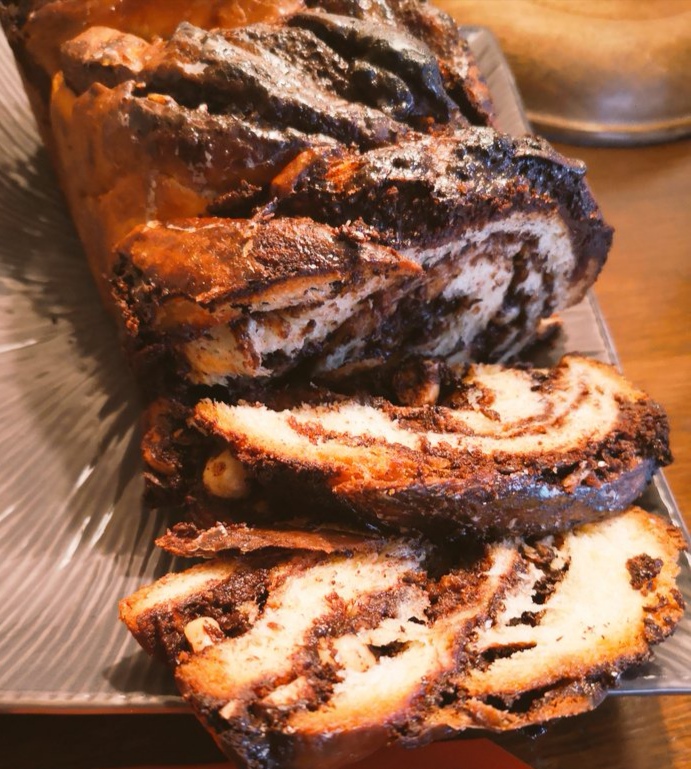
For the first three shows of this series, I’ve baked my version of the signature challenge, this time I went with the technical option and baked a babka. To be honest, before this week my knowledge of babka didn’t go much beyond remembering the Seinfeld episode where  Elaine & Jerry were frustrated in their efforts to take one to a dinner party. In the last few days I’ve been doing some background reading and now know they originated in the Jewess communities of Poland and Ukraine and are particularly popular in Israeli and New York bakeries, hence the Seinfeld episode.

Now I’ve made one and tasted babka for the first time I’m an instant convert. The mixture of the soft, rich dough and the hazelnut filled chocolate in each bite is gorgeous. The many stages of the process and the time needed for proving may mean this isn’t an everyday bake, but there will definitely be babka again soon in this house.

Please don’t be put off by the length of the recipe. The process is broken down to a very granular level, so your hands-on time is not as bad as it might look at first glance. The times listed for proving the dough are a minimum and you can leave it overnight if that’s easier for your schedule.

Ingredients

For the filling

  • 65g blanched hazelnuts
  • 100g unsalted butter
  • 150g caster sugar
  • 80g dark chocolate
  • 40g cocoa powder

For the dough

  • 275g plain flour
  • 5g dried yeast
  • 25g caster sugar
  • 0.5 tsp salt
  • 2 eggs, beaten
  • 50ml milk, ideally full fat
  • 80g butter

For the syrup

  • 100ml water
  • 100g caster sugar

Method

  • Heat the oven to 200°C/180°C fan/Gas 6.
  • Make the filling. Tip the hazelnuts into a baking tray and roast in the bottom of the oven for 4–5 minutes, tossing occasionally, until light golden. Tip onto a chopping board, leave to cool, then roughly chop half the hazelnuts and finely chop the remainder. Set aside.
  • Place the butter, sugar and chocolate in a pan and melt very slowly over a low heat, stirring until smooth and combined. Remove from the heat and stir in the cocoa powder. Pour into a bowl and leave to cool and thicken slightly.
  • Meanwhile, make the dough. Tip the flour into the bowl of a stand mixer fitted with the dough hook, add the yeast to one side of the bowl and the sugar and salt to the other side.
  • Make a well in the centre and pour in the eggs and milk, then mix on slow speed for 2–3 minutes, until firm.
  • Increase the speed to medium and add the butter, a little at a time. Mix well between each addition, allowing the butter to incorporate before adding more.
  • Once you have added all the butter, continue kneading with the dough hook on medium speed through the sticky stage, until you have a ball of smooth, silky, shiny dough. Be warned that this stage can take quite some time. Probably longed that you have ever had to knead dough before.
  • Lightly flour a work surface and roll out the dough to a 40 x 30cm rectangle, with a long edge closest to you.
  • Spread the cooled chocolate mixture over the dough, leaving a 1cm border all around. Sprinkle all the toasted hazelnuts over the top.
  • Starting from the long edge closest to you, roll up the dough into a tight spiral, with the seam underneath.
  • Trim about 2cm off each end to neaten, then turn the roll through 90° clockwise so that a short end is closest to you. Using a large, sharp knife or a pizza cutter, slice lengthways, down through the middle of the dough, cutting it into 2 long pieces.
  • With the cut-sides facing upwards, gently press the top end of each half together to seal, then lift the right half over the left half, followed by the left half over the right half. Repeat, twisting the dough to make a two-stranded plait, then gently press the bottom ends together to seal.
  • Carefully lift the loaf into the lined tin and cover with a clean tea towel (or place in a proving bag, if you have one). Leave at room temperature for about 2 hours (or in a proving drawer for 1 hour), until doubled in size.
  • Fifteen minutes before the end of the proving time, heat the oven to 190°C/170°C fan/Gas 5.
  • When the babka has proved, bake it for 15 minutes, then reduce the oven temperature to 170°C/150°C fan/Gas 3 and cook for a further 25–30 minutes, until a skewer inserted into the centre comes out clean.
  • While the babka is baking, make the syrup. Tip the sugar and 100ml water into a small pan, bring to the boil over a medium heat, stirring until the sugar dissolves. Reduce the heat and simmer, without stirring, for 5 minutes, until syrupy. Leave to cool.
  • When the babka is ready, transfer it in the tin to a wire rack. Brush the cooled syrup over the hot babka, then leave in the tin until warm enough to handle. Turn out onto the wire rack and serve warm or at room temperature.

Great British Bake Off 2020 week 3

There’s something about making bread that almost acts as a dividing line between bakers. There aren’t many amongst us who won’t make the occasional cake, maybe now and again have a go at some scones and if feeling really adventurous there might be a special occasion pie. Bread is different though, no one just seems to bake the occasional loaf, once you’ve made your first it quickly becomes the bake you go to most often. Part of this can be put down to bread being such a staple, something which no breakfast or lunch is complete without. Beyond that, I think it’s the alchemy of bread baking which hooks you. Taking those few base ingredients and transforming them into something which looks, tastes and smells so good.

All of which is a way of saying it was bread week on the Bake Off.

This time around the challenges were to produce two loaves of soda bread for their signature bake, one savoury and one sweet, to make a batch of rainbow bagels for the technical and to make a bread plaque for the show stopper.

If you clicked on the bagel link you’ll already know that not only do they look remarkably unappetising, what’s the point of baking something that you’re not sure you will want to eat, but also they need a large array of food colouring pastes. I only have a couple of these in the house and as I’m still trying to keep shopping expeditions to a minimum I didn’t feel like getting masked up and going out to look for them.

Bread plaques are a work of art created out of dough. I believe they date back to harvest festivals and were seen as a way of celebrating a bountiful harvest. I can’t help feeling that it’s another bake where if you’re not careful the look is taking precedent over the taste. Having said that, there were some remarkable bakes.

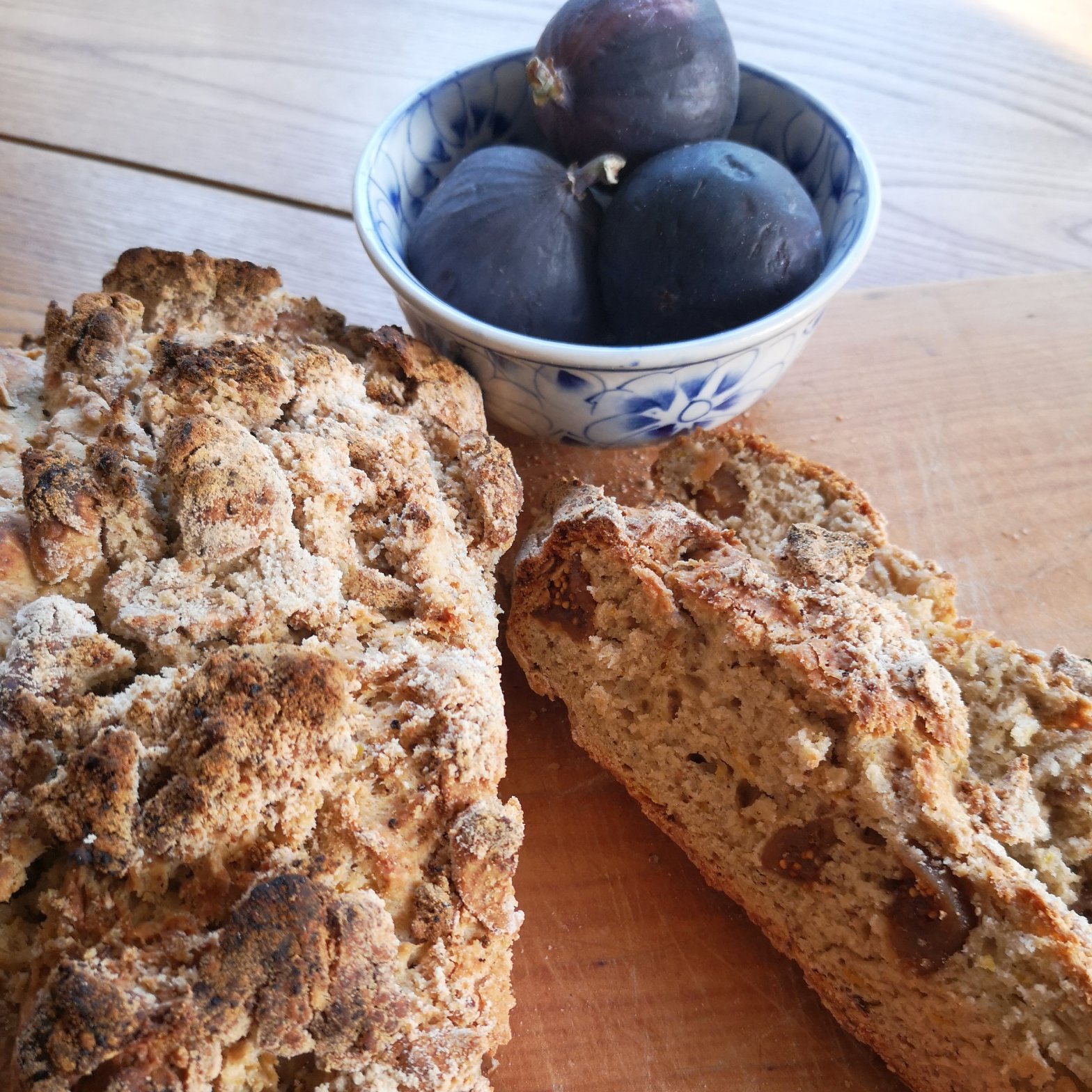
So having ruled out the technical and the showstopper it was time to make some soda bread this weekend. If you are one of the people who has been put off making bread by worries about the kneading the dough requires and then the extended time for proving. this is where you should start. Neither of these things is required with soda bread as there is no yeast in it. It’s much closer to cake making as all you do is combine the ingredients, put them in the oven and bake. It’s as easy as that.

The recipe I opted for is one I saw in an Ottolenghi column in the Guardian a few weeks ago, one which went straight on to my ‘to bake’ list as soon as I read it.

I will just forewarn you though, this makes an absolute monster. Unless you’re baking for some very big appetites you could half all ingredient amounts and still have a good size loaf.  As I didn’t spot this until I’d baked it, I’ve frozen half of mine.

Ingredients

  • 180ml milk
  • 240g Greek-style yoghurt
  • 1 egg
  • 1 tbsp of orange zest..this equates to approximately two oranges.
  • 2 tsp ground star anise
  • 1 tsp ground cinnamon
  • 40g caster sugar
  • 1 tsp bicarbonate of soda
  • 0.5 tsp baking powder
  • 1 tsp salt
  • 70g unsalted butter..cold and cut into cubes
  • 150g soft dried figs..stalks removed and fruit cut into small chunks

Method

  • Preheat oven to gas mark six and line a baking tray
  • Whisk together the milk, yoghurt, egg and orange zest
  • In another bowl mix the flour, spices, sugar, bicarb, baking powder and salt. Then rub in the cubed butter with your fingers until the mix resembles bread crumbs.
  • Stir in the chopped figs and then add the wet mixture. Stir until just combined.
  • As the dough will be wet you will need to put some flour on your hands before you transfer it from the bowl to the lined baking tray. Once done gently shape the dough into a circular mound. Use a knife to score a deep cross in the top and then bake for 45 minutes.
  • When you first take the bread out of the oven it will feel quite crumbly, but it will firm up as it cools

This slightly sweet bread is wonderful if you serve it with some cheese.

Spur of the moment baking.

Some days my baking is a project, the result of great planning and cookbook scanning. Other days it’s spur of the moment, what’s in the cupboards, what needs using. Yesterday was one of those. A ‘let’s see what we’ve got ‘day.

Like so many people during lockdown, and the strange semi lockdown we’ve drifted into, I know I’ve probably been overdoing it on the sweet treat baking. What used to be a weekend thing has slowly stretched out to fill the week. Somehow there just has to be a little something sweet to go with my mid-evening cup of coffee. I’m conscious of the sugar levels involved and do try to keep the more indulgent baking to the weekends, or at least I like to think I do. Over all, I feel there are worse vices than baking.

Yesterday there was the additional issue of it being Bake Off evening on TV. Ninety minutes of watching bakers at work were never going to pass without the need of some sustenance. A sugar rush to keep me going. The coconut macaroons I baked at the weekend were long gone, so what was a boy to do.

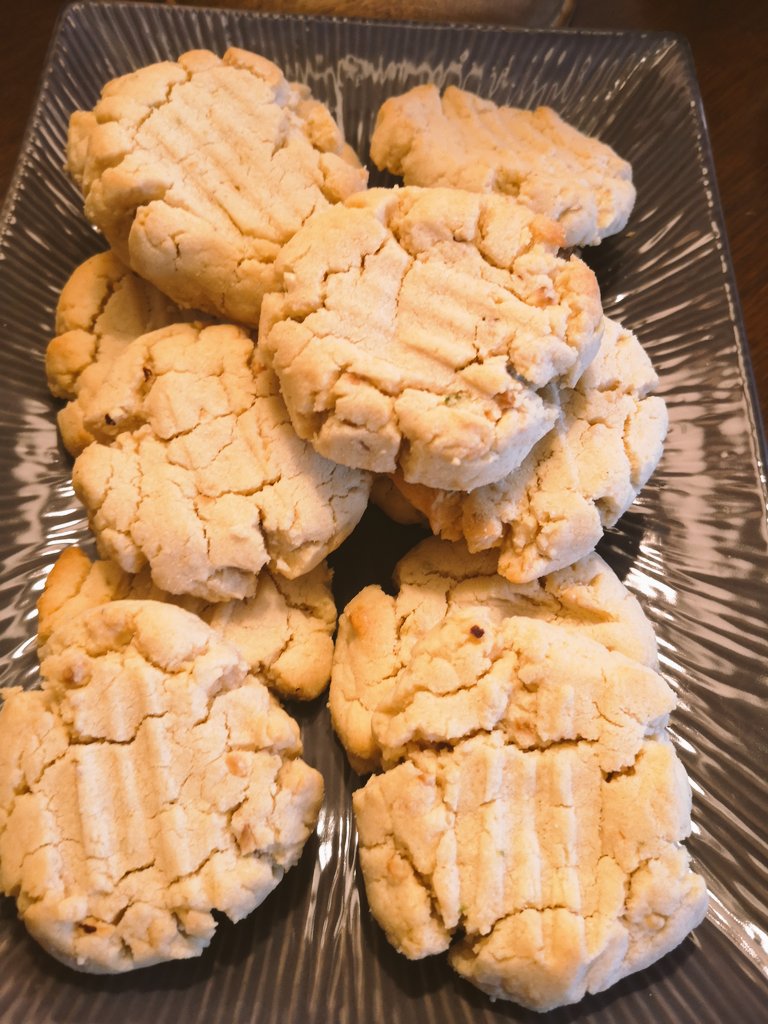
A quick hunt through the kitchen found me some limes in the fruit bowl which were in danger of turning into green golf balls if left too much longer, a half jar of tahini paste that had worked it’s way to the back of the fridge, and the remains of a pack of chopped hazelnuts from a previous project. A perfect combination for baking a version one of my favourite biscuit recipes. Previously it’s been lemon & tahini shortbreads, but after yesterday they have a rival in the lime, hazelnut & tahini version. The lime flavour is a bit subtler than the lemon, while the chopped hazelnuts add extra texture to these crumbly biscuits.

Ingredients

  • 120g unsalted butter..softened
  • 120g tahini
  • 120g caster sugar
  • Zest & juice of 2 limes
  • 240g plain flour
  • 30g chopped hazelnuts..as long as they are finely chopped most nuts would work. Pistachio would be particularly good.
  • 1tsp baking powder

Method

  • Preheat the oven to gas mark 4 and line a baking tray
  • Cream the butter, tahini and sugar together until pale. Then mix in the lime zest and juice.
  • Combine the flour, nuts and baking powder in another bowl. Stir this mixture into the wet ingredients and gently combine. Mashing it with a fork works better than trying to stir it.
  • Roll the mixture into small balls and place them on the baking sheet. I made 14, but they were a bit on the large size. Pat each ball into a disc, you can either use your hand or a fork for this.
  • Bake in the oven for approximately 15 minutes. When they are ready the edges of the biscuits should be golden brown.
  • Leave the biscuits to cool 100% on the tray. If you try to move them too early they will crumble.

I think I might try an orange and pistachio combination next.

Great British Bake Off 2020 week 2

Bake Off week two and it’s biscuits..or is it.

For the second year running this round had bakers taking to social media and questioning whether  the bake picked as the technical challenge actually qualified as a biscuit. Last year it was fig rolls lighting up Twitter, this year it was macaroons. My take is that both bakes probably sit in a halfway house between biscuit or cake and could probably fall under either category.

An additional confusion for me is I’ve always struggled to tell my macaroons from my macarons. I really thought I’d cracked it this time and was settling down to watch the bakers make small meringue type treats, only to realise they are the one with the single o and it’s the delicacies made with coconut that have the double o.

The signature challenges the bakers faced this week were to produce a batch of Florentine biscuits to their own recipe. The showstopper challenge was every bit as bonkers as last week’s cake busts, this time it was to create a 3D table setting out of different types of biscuits. That’s cutlery, crockery and food to serve with it. These showstoppers may make for good television but it does feel as if it’s baking where the look of what’s being produced is inevitably going to take precedent of flavour.

Having finally sorted out my macaroon confusion, I decided to make a batch, particularly as it’s not a bake I’ve done before. My initial thoughts were to use the recipe from the show but I quickly ruled it out because what was already going to be a very sweet treat hardly needed condensed milk as well. There was also an issue around where was I going to get mango puree from.

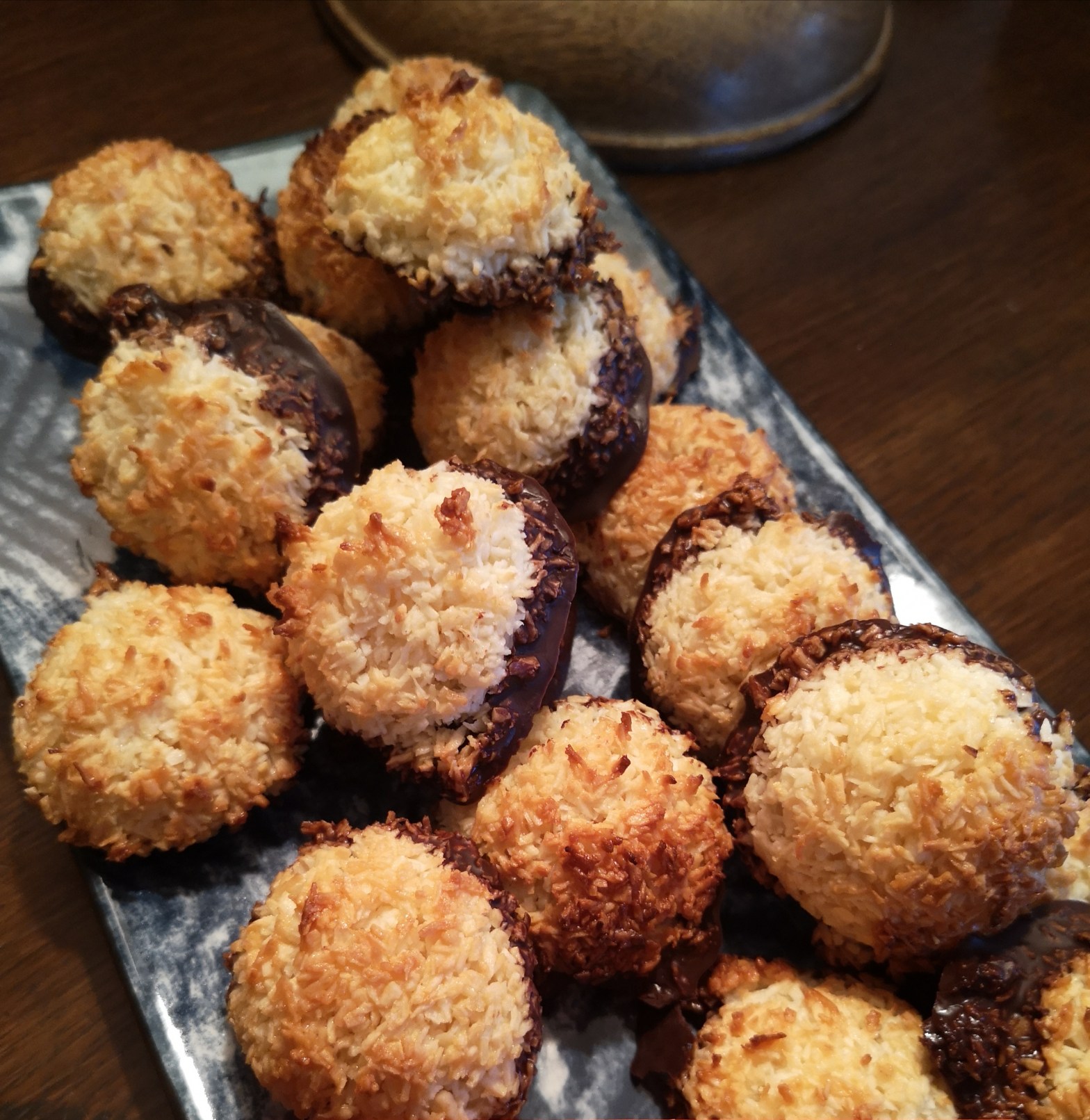
The recipe I used is for coconut macaroon kisses. Small one bite, two if you’re delicate, coconut treats which have been dipped in chocolate. Even without the condensed milk, these are quite sweet, so my advice if you make them is to use a strong chocolate. Go for a dark one with a high cocoa content, the bitter edge will work well with the sweet coconut.

Don’t be put off by the mention of making a creme patisserie. It’s very straight forward and is integral to the flavour of the finished bake.

The recipe makes 20 and although it may sound like a lot I assure they’re gorgeous and won’t last very long. I’ve just checked the batch I made yesterday and it’s already half gone.

Ingredients

For the patisserie

  • 5 tbsp milk (ideally this should be full fat and creamy)
  • 3tbsp caster sugar
  • 1 tbsp cornflour
  • 1 egg yolk

For the coconut mixture

  • 3 egg whites
  • 0.5tsp vanilla extract
  • 100g caster sugar
  • 200g desiccated coconut

For the chocolate glaze

  • 100g dark chocolate
  • 2 tbsp sunflower oil

Method

  • For the patisserie heat the milk in a saucepan until steaming, then remove from the heat. Put the sugar, cornflour and egg yolk in a bowl and beat until pale and smooth. Gradually stir in the hot milk and then pour the mixture back into the saucepan. Over a low to medium heat whisk the mixture until it thickens.
  • Heat the oven to gas mark 3
  • For the coconut mixture put the egg whites and vanilla in a bowl and mix together. Add the sugar and beat the mixture until the sugar has melted. Stir in the coconut and then add the patisserie mixture. Stir everything together until smooth.
  • Line a baking sheet and put scoops of the mixture onto it. I used a tablespoon measure and that gave me 20 smooth mounds.
  • Place in the oven and bake for 20 minutes. When you take them out they should be slightly golden and darker around the edges. Leave on the tray to cool completely.
  • Melt the chocolate in a heatproof bowl over a saucepan of simmering water. Once melted stir the oil into the chocolate. The addition of the oil helps to give a glossy finish.
  • Carefully pick up the macaroons and dip them into the chocolate. You’re looking to just cover the bottom of them.
  • Place the macaroons, chocolate side down, on a clean piece of baking paper and leave them to set. When they’re ready they should just peel off and not leave any chocolate behind. If you’re getting desperate for a taste by this point you can always put them in the fridge to speed up the process.

Writing prompts

As much as I enjoy putting this blog together, I do sometimes struggle with knowing what to write about. Sometimes I’ll sit down with a clear idea in my head and the words come fairly easily, other times it’s with a hope of inspiration but a realisation that Twitter or Spotify may soon distract me.

On those days, when I’m staring at a blank page, I often find myself heading towards the various writing challenges and prompts that Twitter offers. The further I dig the more I find, but my favourites are a haiku challenge which is posted by baffled, a ten word story challenge posted by hangtenstories and an indeterminate length story challenge called #vss365. I’m not quite sure on the source of this one, but you’ll find the prompt if you use that hashtag. All of these post a fresh daily prompt and although the character restrictions on Twitter lead to short pieces of writing, it really is a great way of getting the creative juices flowing.

My friend AlisonTrollop has recently started to put some writing challenges up on her Patreon blog. The first of these was to write a story of no more than 250 words around the prompt word of aural.

I drafted a few ideas for this but in the end decided  to have a go at amended and editing something that I’d previously written, into a format that met Alison’s challenge. This was first produced for the creative writing course that I took and I have posted a version of it on here previously. It got some interesting feedback when I shared it, some said it felt as if it was the start of a love story, others felt there was an uncomfortable edge to it. Perhaps I should extend it and see which route it takes.  

Most days he’d spend the journey with his head in a book, oblivious to those around him. The girl with the broken mirror changed things.

He’d first noticed her a few weeks ago, sat on her own, three rows in front, the sound of her rustling through her makeup bag drawing his attention. Intrigued by the way she then stared intently into a cracked, broken mirror she held in one hand, whilst with the other delicately applying makeup. The mirror so damaged the shards might fall out if tipped the wrong way. The makeup application so precise it was clear the fragmented image didn’t bother her at all. 

The bus seldom halted before his stop, but that day it did. He knew it was going to be for her. She never looked back as she walked down the bus, never looked around as she got off. He could have looked over his shoulder and tried to catch a glimpse of her as the bus pulled away, but something stopped him.

After that, her morning ritual became part of his. He got to know where they should be on the journey when the eyeliner came out, how long there was to go when the blusher was applied. Every day it ended the same way. She’d get up and walk away, he’d never got to see her face. Never got to see the image she’d created using her broken mirror.

He still wonders what the girl with the cracked mirror looked like.

Great British Bake Off 2020 week 1

It’s Bake Off time again. After assuming all summer the show was going to be another 2020 corona casualty they’ve defied all of our expectations and the new series started on Tuesday evening. A ninety-minute baking extravaganza and I’m hooked for the next ten weeks. Yes I know it’s all a bit cliched,  but there’s something about a competitive, yet supportive baking group which just draws me in.

I didn’t discover Bake Off until season four ( the Ruby Tandoh year if you’re a fan ) but since then it’s been an annual highlight. I’ve baked along with it, have various related books on my shelf and even had a couple of goes at applying to be on it. As I got further on the second application than the first I’m hoping if I try again it just might be third time lucky

In the unlikely event of you not having seen the show, let me explain the format. There are twelve  bakers at the start of the season. Each week is themed to a particular baking style, for example, cake, biscuits, bread etc. Each show is then split into three bakes, the first is the contestants signature bake for the week’s style, the second a technical challenge and the third a show stopper. At the end of each show, one baker is crowned the star baker and another is sent home. This process continues until the final three bakers contest the final.

This series opened with cake week. The signature challenge was a Battenberg cake, the technical a batch of individual pineapple upside down-cakes and the show stopper the somewhat bizarre idea of creating a cake bust of one of your heroes. If you don’t think the cake bust idea sounds odd, just click on the link and you’ll see what I mean.

I’m going to have a go at one of the challenges each week and this time the decision was easy. Cake busts were a no go and my local stores were unlikely to have the fresh pineapple required for the upside-down cakes, so it had to be a first attempt at making a Battenberg.

To me, a Battenberg has always felt like a shop-bought cake, the sort of thing I remember from childhood where part of the fun was peeling off the marzipan to eat it separately from the brightly coloured cake that it encased. If Battenberg is new to you I should explain, they consist of four pieces of sponge cake, two yellow and two pink, these are held together with jam and then encased in marzipan. The coloured cakes are combined to give the chequered pattern which you can see in the photo. 

I hadn’t appreciated until this week that they’re a uniquely British bake, dating back to Victorian times. Some food historians claim they were first created for the marriage of Queen Victoria’s granddaughter to a Battenberg prince. Even if this can’t be verified it is accepted that recipes first appeared in the late 1800s. Some of the originals had multiple squares, but over time four has become the norm.

Being a novice I had to do some recipe hunting, I opted for this one by Felicity Cloake and I’m glad I did. In my original plans, I’d assumed I would have to use food colouring for the pink cake but Felicity’s idea of using freeze-dried raspberries is ideal. Once you’ve ground them down you get a lovely raspberry flavour to the cake, as well as the colour you’re looking for.

If you are tempted to have a go I will forewarn you, this is quite a fiddly bake. Cutting the cakes to the right size and then assembling them felt a bit like baking Jenga, made even more difficult by the fact that everything is coated in jam and then wrapped in marzipan. By the end, I was one very sticky baker.

I’m glad I made it though. It’s always good to learn some new skills and the general consensus is that it more than matches up to the shop-bought version people remember.

Next time its biscuit week.

Baking buzz

With the nights drawing in and the coronavirus news getting bleaker by the day there has never felt like a better time for the return of Bake Off. For the next ten weeks on a Tuesday evening, we can pull the curtains, pour a cup of tea, cut a slice of cake and collectively all get a little bit high on baking powder and icing sugar.

That may sound a little over the top but I have fond memories of attending the Cake & Bake Show in London a couple of years ago and I can genuinely say I don’t think I’ve ever been in the company of quite such a happy bunch of people. Whether it was the joy of being in an exhibition centre where everything was baking-themed or the mother of all sugar rushes, they were all smiling and loving the moment. It felt a bit like being at the baking equivalent of Glastonbury.

Its that baking buzz which sees me taking every opportunity to indulge, never happier than when I can decamp to the kitchen, choose my playlist and just shut the rest of the world out for a few hours. Yesterday was one of those days and the picture with this post shows the fruits of my labours.

First up was a loaf of bread baked with my new favourite flour. Until recently I hadn’t thought too much about the source of the flours I used. As long as I could get a regular supply I was happy. It was the shortages in the early days of lockdown which started to change things. Flour wasn’t on the store shelves and I had to hunt around to see if I could get it from anywhere else, that’s when I discovered Letheringsett Watermill They make flour in the traditional stone-ground way and source their grain from local farmers. I won’t deny the flour they produce is a little more expensive than what I have been buying, but the wonderful flavour of the bread it produces more than compensates. A case of getting what you pay for.

My second bake was a batch of bread rolls which have harissa, olives and feta mixed into a dough enriched with butter and eggs. The result is a light and fluffy bread with a lovely mix of salty tang and delicate heat in the aftertaste. I found the recipe in a column by Benjamin Ebuehi in the Guardian a few weeks back and this is the second batch I’ve made. One of the beauties of the recipe is that however good a combination harissa, olives and feta may be, it would probably work with a whole array of savoury options you might have available in your fridge.

After a couple of savoury bakes, I rounded off the day with chocolate and pear pudding. This is another Guardian recipe and comes from Felicity Cloake’s column where she looks at the various options for making a particular dish and comes up with the perfect version. This may look like a  simple recipe but I can assure that gently frying the pears in butter and brown sugar takes it into the realms of perfect.

The unfortunate downside of baking so much in one go is we won’t need anything for a couple of days now. The upside is I’m expecting tomorrow evenings Bake Off to give me lots of new ideas.

Baking with fruit from the garden.

I’m beginning to discover the joys of cooking with ingredients which I’ve been involved with growing.

Gardening has never been one of my strong points, mowing the lawn is about as far as it normally gets. Beyond that, I tend to think of the garden as somewhere to sit in the sun with a good book and either a coffee or a glass of wine to drink. Which means, given the average UK weather, there are quite a few months of the year when I hardly venture out there at all.

This was until the last few months. Maybe it’s been a rare positive lockdown by-product, but these recent times have seen me and my partner out in the garden on a more regular basis, and it’s beginning to have an impact in the kitchen.

One of my pet peeves on shopping expeditions has always been the price of fresh herbs. An exorbitant amount for a modest size bunch, although still more than you need, the rest slowly going soggy in the fridge before finally being thrown out. It’s beginning to change now though as I can ignore the herb racks in the store knowing most of the ones I need are growing in pots just outside our backdoor. They probably won’t see me through the winter but it’s been fun to go out and pick fresh herbs as and when they’re needed.

Another project has been growing courgettes, or zucchini as you may know them if reading this outside of the UK. Because our garden is virtually all grass we were pretty limited when it came to having a go at growing vegetables but we did find a small patch where we could squeeze these in. There didn’t seem to be much happening for a while but in the last couple of weeks the care and attention lavished on them has paid off. I’m not sure if it’s my imagination but a courgette coming straight from the garden into whatever dish is being produced seems to have so much more flavour than any we’ve previously bought in shops. An added bonus is the brilliant yellow flowers which the plant produces, I’m already looking for recipes to see how we can make use of these.

Last week we reaped home produce benefit when my partner gathered some pears from the tree at the bottom of our garden. Normally it’s not the most productive of tree’s, but this year it’s laden with fruit. When she first got them they were so hard I swear you could have hammered nails in with them, but a couple of days sitting on a sunny window sill soon resolved this and by the weekend they were perfect for baking. I normally make this cake with apples but the recipe works just as well when adapted for pears.

Ingredients

  • Zest & juice of one lemon
  • 3 small apples diced, skin on. 
  • 40g dark chocolate
  • 2 eggs
  • 160g caster sugar
  • 130ml vegetable oil
  • 150g paling flour
  • 1.5tsp baking powder
  • 1tsp ground nutmeg
  • 1tsp ground fennel seeds
  • pinch of salt

Method

  • Heat the oven to gas mark 4, grease and line a 1kg loaf tin.
  • Put the lemon juice & zest into a bowl. Dice the pears and toss them in the lemon mix
  • Chop the chocolate into slivers
  • Whisk the sugar and eggs until pale. Slowly pour in the oil and continue to whisk until combined.
  • Mix all of the dry ingredients and then fold them into the egg & sugar mix until combined.
  • Fold in the diced pears along with the lemon juice & zest. Then fold in the chocolate.
  • Pour into the lined tin and place in the oven.
  • Bake for 35 minutes, then turn the tin around and bake for a further 15 minutes. If your oven runs hot it might be advisable to cover the cake with foil for the last part of the bake.
  • Leave to cool, in the tin for 15 minutes, then turn onto a rack.

So with the news starting to look as if more lockdowns may not be too far off, I think the garden may be getting even more attention from us.

.

Design a site like this with WordPress.com
Get started